
ELD (Electronic Leak Detection)
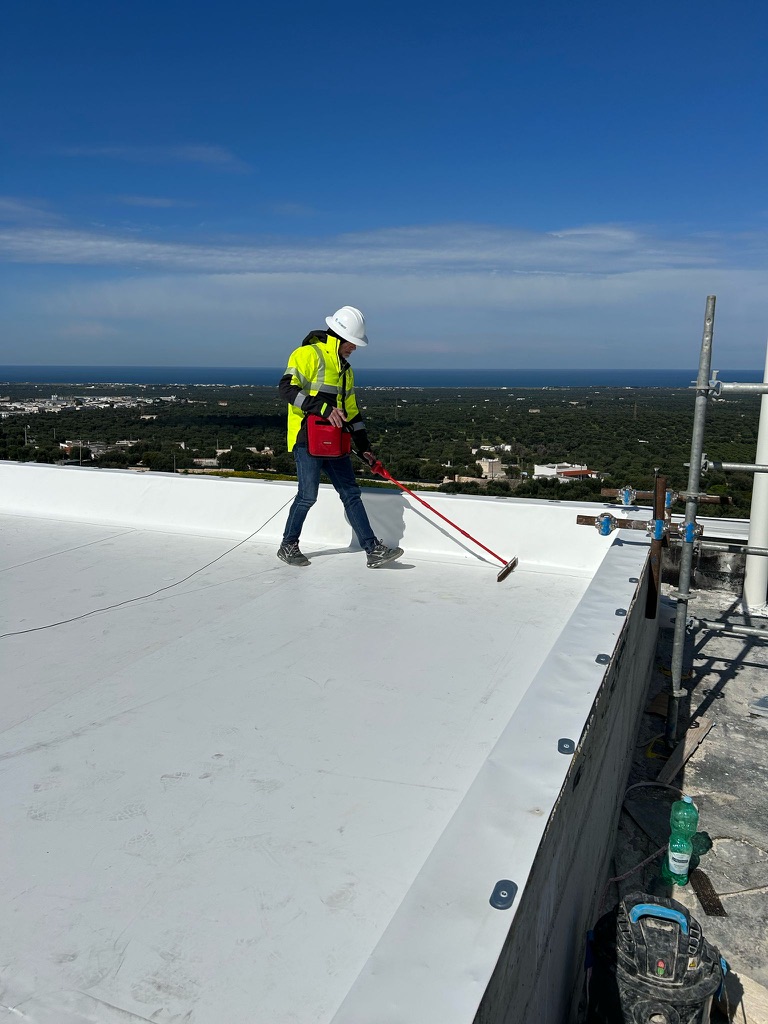
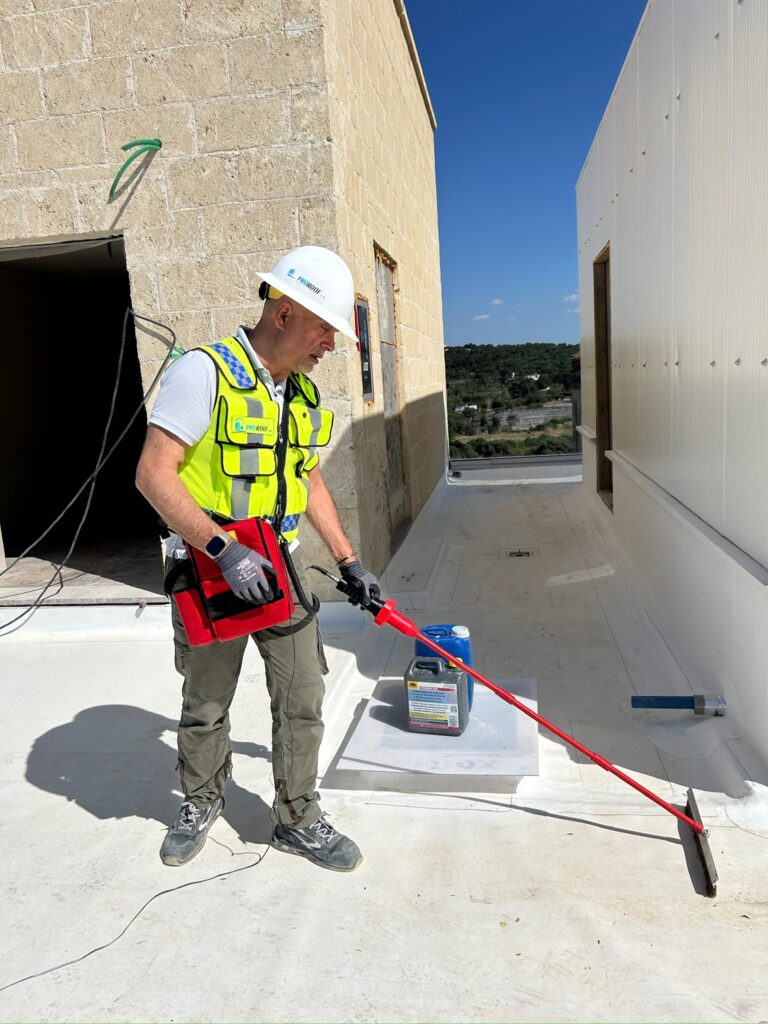
This system can be distinguished between wet and dry, depending on the characteristics of the surface to be examined.
Dry
In the case of a dry and/or semi-dry waterproofing membrane, testing will be carried out using high-tension technology, better defined as the dry method.
This system makes it possible to check and test non-conductive waterproofing membranes using high voltage technology by exploiting the dielectric structure of the coating.
The loss of dielectric capacity of the coating, due to its alteration, allows the ELD to detect holes, damage and vulcanisation discontinuities.
The dry method involves the use of state-of-the-art, microprocessor-controlled instrumentation designed to provide a stabilised DC output voltage that can be adjusted according to the thickness of the coating.
A low-voltage coiled cable connects the detection unit to the test probe.
The test voltage will come:
- or automatically calculated by the instrument by setting the thickness of the coating with reference to preset BS EN-50356 criteria (if manufacturer's data sheets are available);
- o calculated with a sample of the roof covering present in the building, according to BS EN 60052:2002 criteria.
In fact, the test is based on connecting the structure in negative, by means of a ground cable connected directly to the detector, and traversing the entire surface with a probe, which generates high voltage, in search of discontinuities in the vulcanisations and/or damage to the waterproof covering.
The detection of an anomaly will be indicated by an audible alarm followed by the illumination of a red LED on the front panel of the detector.
If there are any discontinuities in the vulcanisation, holes or cuts in the mantle, an arc spark will also be generated.
Wet
If the waterproofing membrane is particularly wet, it will be tested using the “wet” method.
This system, based on low-voltage technology, involves the use of a conductive cable that will form a loop within which the test will be carried out. This test involves the use of a pulse generator that produces low-voltage current.
A cable connects the generator to the structure, the current propagates over the test surface through two probes generating a pulse.
If there is an anomaly on the mantle, the detection device directs the operator to exactly where it is located.